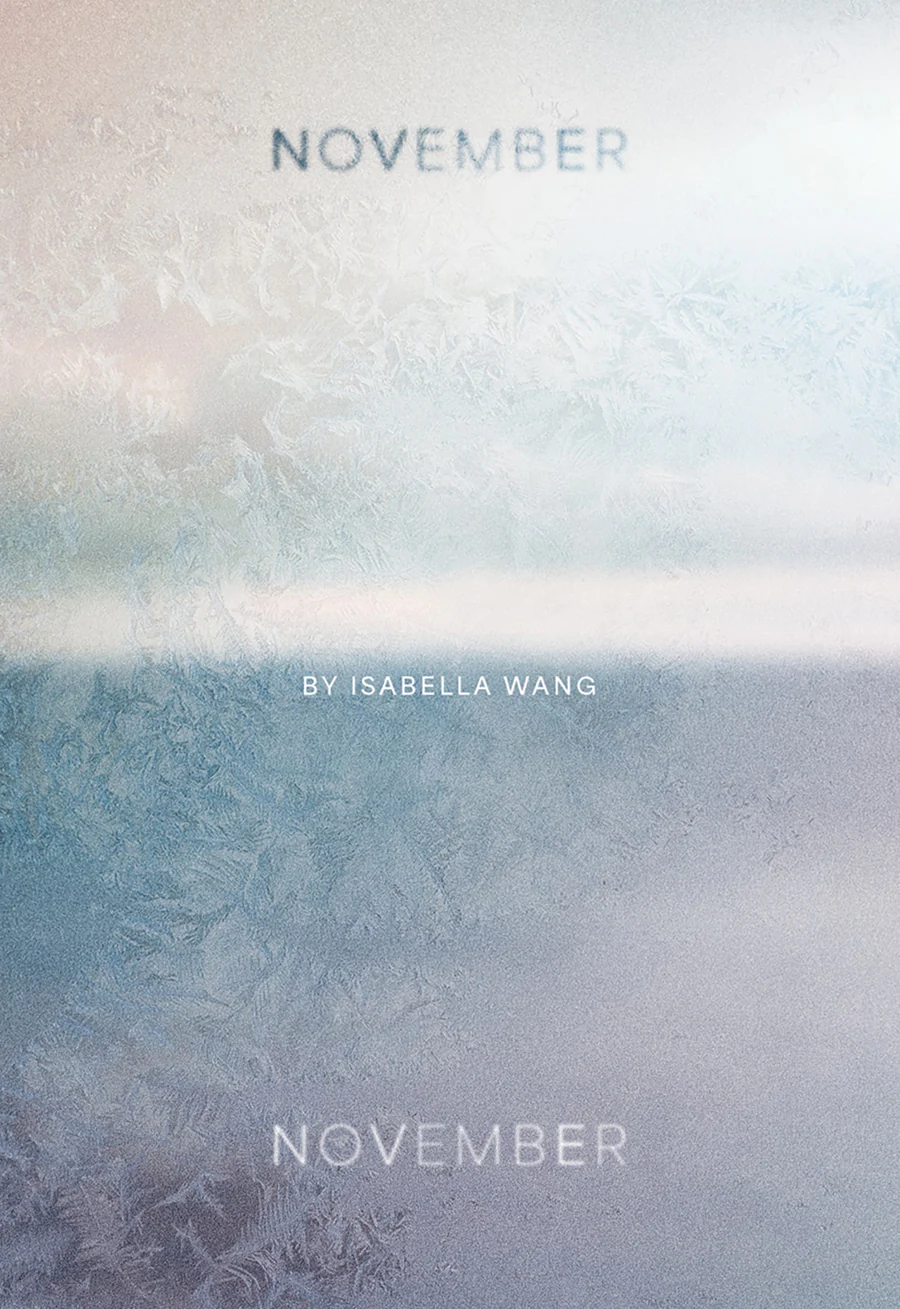
November, November
November, November
By Isabella Wang
Poetry
Harbour Publishing, 2025
103 pages
ISBN: 9780889714847
$19.95
Reviewed by Bri Hepner
November, November is a meditative collection of poetry that addresses grief, memory, mortality, and poetic inheritance. Many of the poems read like intimate and confessional letters to lost poets and mourning friends. The point of view moves from personal suffering to collective loss, at once contemplative and vulnerable.
The book is structured over several “passages” spanning Novembers that chart the death of a mentor poet, Phyllis Webb, the authors cancer diagnosis and treatment, and her recovery and reflection. Webb writes that “poetry isn’t / just in the song of the grieving / but right now it sings / the song of our most natural grieving / Phyllis knows we’ve dreamt.”
Wang’s style does not adhere to formal poetic constraints. Instead, it embraces experimentation. Throughout the entire first section –Constellations, November 2020 — the poems are constrained by black-lined boxes.
As the reader moves into passage two, the words break free of this form and create a new space through long sequences, free verse, broken punctuation, and spatial play on the page to represent “the unwritable / punctuations of early December” while embracing the “runs out of the columns / of cryptography inspiration.”
This looseness reflects the shifting emotional landscapes and the disorientation that comes with mourning rituals. We see Wang work toward a parallel between broken punctuation and a broken-down body. In her poem “The Patient is a Body,” it “cannot spell / or read” and “speaks in metaphors.”
We might also read Wang’s experimentation as a meditation on the limits of language itself. The fragmentation of syntax and the visual disruption on the page not only mirror grief, but actively resist consistency, suggesting that experiences like illness and mourning cannot be fully articulated.
The poems capture a kind of failure that is generative rather than limiting. When language falters, Wang turns to spacing, silence, and visual constraint as alternative modes of expression. These moments invite the reader to participate more actively in making meaning. The collection does not seek resolution, but instead dwells in uncertainty, and functions as the “music toward the movement of closure.”
Wang returns to grief in a different form in the second section where she receives her cancer diagnosis and claims that “there are people / you love you won’t tell until the holidays are over.” This temporal structure gives the poems space to show how grief changes shape.
Due to its deeply personal and occasionally cryptic storyline, this collection may not speak to every reader, but grief is not neat and illness is not linear. For readers willing to sit with these difficult emotions, beauty awaits. Wang’s collection helps us understand that “some days we don’t get to rewrite / the history of our bodies.”
Compared with the author’s previous work, Pebble Swing (2021), which dealt with language, memory, family history, immigrant identity, and linguistic loss, November, November shifts focus from external histories and cultural displacement to internal crisis.
Isabella Wang was born in eastern China and immigrated to Canada as a child. She lives in Vancouver,and studies English and World Literature at Simon Fraser University. Her earlier works include On Forgetting a Language (2019) and Pebble Swing (2021), which was a finalist for the Dorothy Livesay Poetry Prize. Wang also directs a non-profit editing and mentorship program called Revise-Revision Street.

