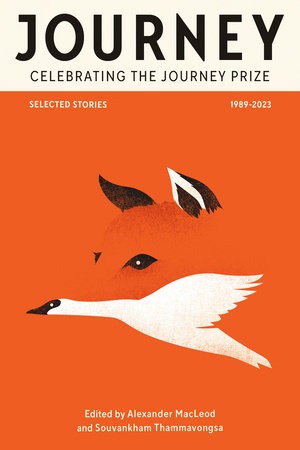
Journey: Celebrating the Journey Prize
Journey: Celebrating the Journey Prize
Edited by Alexander MacLeod and Souvankham Thammavongsa
McClelland & Stewart, 2024
368 pages
ISBN: 9780771007439
$38.00
Reviewed by Flynn Connolly Sifton
How can three and a half decades’ worth of prizewinners be reduced to one book? In the case of Journey: Celebrating the Journey Prize, Alexander MacLeod and Souvankham Thammavongsa acknowledge that “there is no possibility for critical consensus” as they harvest 31 exemplary selections from the wealth of past winners and nominees.
The editors selected stories for their ability to surprise, take risks, and to be powerful. It is a refreshing change from more standard criteria. While it is occasionally uneven, and its title is less-than-imaginitive, Journey is a sharp, refreshing volume and a satisfying greatest hits.
We begin with “My Husband’s Jump” by Jessica Grant, a sinewy, fast-paced work of magical realism. A jaded reader might suspect that it’s first to dispel fears that the anthology will be a stuffy academic volume of prizewinners, authoritative and pretentious, but “My Husband’s Jump” is a delightful hook that is funny, bittersweet, and unusual in all the best ways.
From here, the collection unfurls into sustained exercises in voice, as in featured works by Lue Palmer and Thomas King; realistic meditations on family and relationships, such as Annabel Lyon and Mary Borsky’s contributions; and a more brutal magical realism in Martin West’s “My Daughter of the Dead Reeds,” the morbid comedy of André Alexis’ “Despair: Five Stories of Ottawa,” and Michelle Winters wild variation in “Toupée.”
These are carefully ordered for variety, perhaps too carefully ordered, as the reader contrasts a tale loneliness in Toronto after a chronicle of family madness on the prairies. The rise and fall of a rollercoaster is better than thematic clusters—and the coaster’s descent is still a thrill. Each tale achieves precisely what it sets out to accomplish. There are a few missteps that seem to follow a standard template of family strife or creak under wooden dialogue, but these are the exceptions.
A few stories especially stand out: Téa Mutonji’s “The Photographer’s Wife” unfurls in cold scenes of urban ennui, replete with stark portraits of hollow intimacy, and the photographer himself is a maddening, but brilliant creation. Meanwhile, Heather O’Neill blitzes through a word-drunk ramble in three freewheeling pages of “The Difference Between Me and Goldstein.”
“Monsters” by Leanne Toshiko Simpson is especially adept, the kind of story that furiously embodies the shock, risk, and faith MacLeod and Thammavongsa were seeking. The story is clipped but white-hot as it dissects both an individual and the society that created her. Consider its opening: “[t]he man I’m about to marry tells the party that the shooter had a family history of mental illness, and everyone but me nods knowingly because I am too busy thinking that the floor is lava.”
Most of Journey’s material is truly striking. While some aficionados of the prize might disagree with a few of MacLeod and Thammavongsa’s selections, or point out oversights, the phrase “something for everyone” is certainly applicable here.

