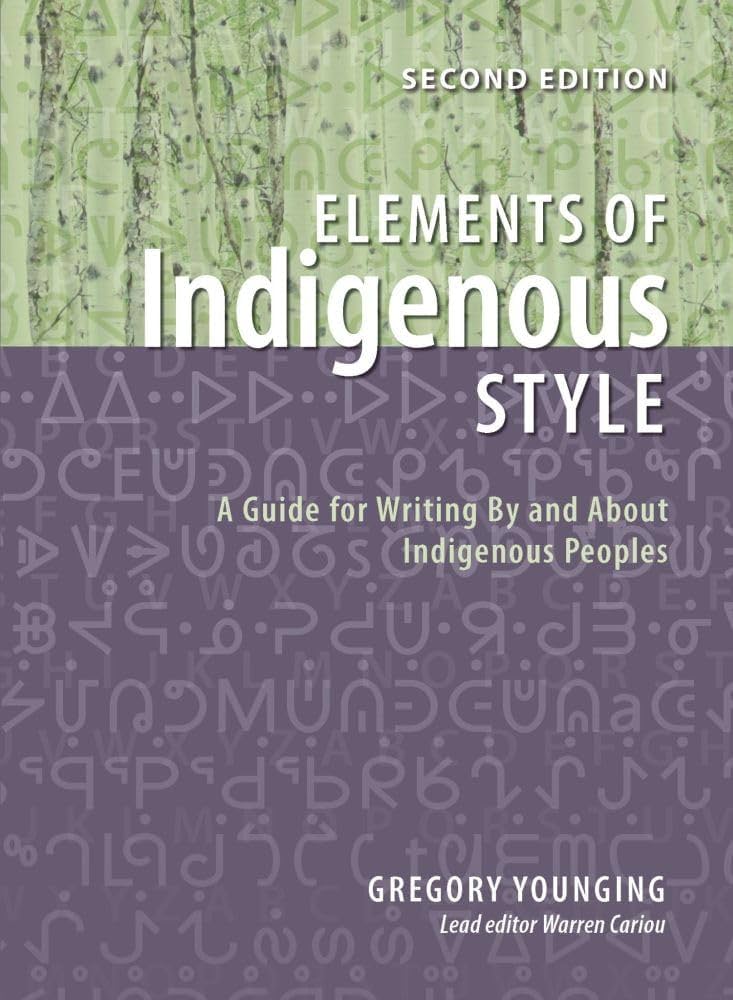
Elements of Indigenous Style, 2nd ed.
Elements of Indigenous Style, 2nd ed.
By Gregory Younging and Warren Cariou
Brush Education, January 2025
Nonfiction
ISBN 9781550599459
256 Pages
$27.95
Reviewed by Masha Zhaksybek
Brush Education published a second edition of Elements of Indigenous Style a year after Gregory Younging passed away and the first edition’s release in 2018. Lead editor Warren Cariou, who had worked with Younging on the first edition, revised with contributing editors Deanna Reder, Lorena Sekwan Fontaine, and Jordan Abel, but split the guide into two “conversations,” preserving Younging’s original work while adding new and relevant material.
The guide’s chapters have clear subheadings, which makes the text very accessible, and specific elements easy to find. Some sections focus more on the impact of language –offensive language, Indigenous colloquial expressions, and capitalization –while others focus on policies, rights, and legal issues, or theory.
It is packed with historical context that supports the framework and tells a story. Part one is embraces a first-person perspective, incorporating Younging’s experiences in the publishing world. Early in the book, he writes, “Many Canadian publishers have a sense that they’re not editing work by and about Indigenous Peoples as well as they could. For the most part, they want to do it right, but often they don’t know how to do it right.”
This purpose shapes the guide, training both Indigenous and non-Indigenous writers to edit the work of Indigenous Peoples with respect and confidence, understanding the cultural implications of their choices.
The guide also covers best practices and emphasizes there no “right way” to do things. As Younging writes, “Finding your way through requires thought, care, attention, and dialogue. It requires working with people.” He also notes that “asking for help is not disrespectful and is always a good step.”
He addresses the clash between Western publishing practices and the practices of Indigenous Peoples, especially in relation to Traditional Knowledge and Oral Tradition. It also grapples with Western copyright law and the Eurocentric habit of “ownership,” showing how these ideas do not always align with Indigenous ways of knowing.
The first conversation is about 100 pages, and the second adds 50 more. The new edition also adds to the appendix, called “Sample Stories: Models of Collaboration and Indigenization in Publishing.” The final part of the appendix still includes Younging’s essay “Gnaritas nullius (no one’s knowledge),” which addresses Western epistemology and its incompatibility with Traditional Knowledge.
Cariou’s conversation is about identity and community affiliation, Indigiqueer stories, and practices that “support Indigenous linguistic and cultural sovereignty.” The final chapter, “Emerging Issues in the Digital Environment,” is an especially relevant addition that reflects current publishing concerns.
This style guide helps editors publish culturally informed work and allows Indigenous communities, authors, and editors to share knowledge about the changing editorial landscape. Elements of Indigenous Style is another step toward decolonizing the literary world and reconciliation.
Gregory Younging was an Indigenous writer, editor, and professor at UBC Okanogan, posthumously recognized with the Association of Canadian Publishers President’s Award. Younging worked as a publisher at Theytus Books, the first and oldest Indigenous-owned publishing house in Canada. He was a member of the Opaskwayak Cree Nation and was known for his expertise in First Nations copyright.

