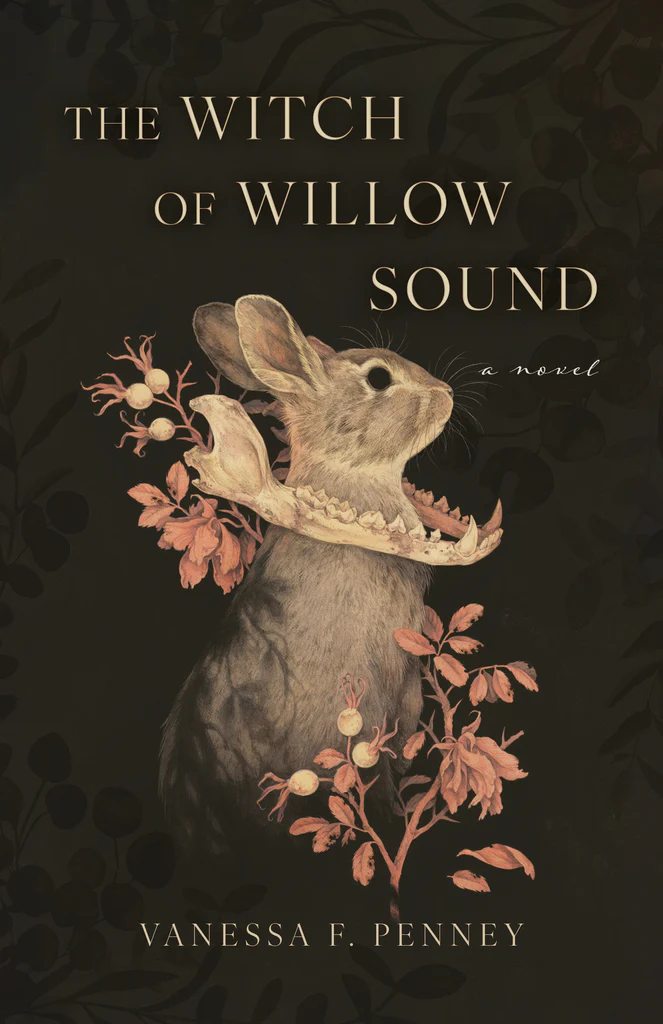
The Witch of Willow Sound
The Witch of Willow Sound
Vanessa F. Penney
Fiction
ECW Press, 2025
320 pages
ISBN: 9781770418424
$19.95
Reviewed by Bailey Bellosillo
Vanessa F. Penney’s debut novel The Witch of Willow Sound is billed as an East Coast feminist gothic and follows Phaedra Luck as she traces the disappearance of her estranged Aunt Madeline, rumoured to be a witch by the locals of Grand Tea, Nova Scotia who blame her for their every misfortune—including an impending hurricane.
Phaedra (Fade) returns to the lonely forest of Willow Sound where she discovers the “fairy tale” cottage of her youth has turned into a nightmare, empty and rotting. The ominous smell of something burnt hangs in the air. Fade conducts her own investigation into the locals, using tricks learnt from her previous career in Cybercrimes.
Law enforcement is quick to point out Madeline was not well-liked. Mayor Dinwald H. Davish hopes for her death and most of the town would like to see her burn; once the witch is gone, the townspeople will be “free.”
No detail is forgotten or accidental. A lingering sense of unease is present even in the novel’s grisly prologue, which features an unnamed Old Woman burning a body chained to a tree. The description is gruesome, but sets the tone even though the supernatural only arrives 100 pages in.
The mystery is well-crafted, and Fade is smart, stubborn, and brave enough to crack it. While her language and sense of humour can feel too juvenile for a protagonist in her 30s, her personality is sharp and authentic. Fade is pragmatic, she knows sexism and racism drive the townspeople’s fear of witches, but she looks deeper: “Magic spell incantations are memory devices. They’re code.”
Fade traces her lineage, hoping to unearth clues in her family history and cultural lore to explain the disappearance of her aunt, why the town thinks that she’s a witch, and why they’re intent on her banishment. Fade uncovers secrets that are heartbreaking: gardens hide mass graves, and children are locked away in bunkers, if not discarded at birth. What originally appears to be a haunting turns into something worse, something real.
Despite her cultural roots being crucial to the plot and characters, Fade’s own identity is deliberately obscured. Originally described as a woman with green eyes and Scottish ancestry on her father’s side, halfway through the novel Penney tells us Fade and her family are of Asian descent.
She shares accounts of the 1923 Chinese Exclusion Act and the Nova Scotia Home for Colored Children at this juncture, but this history would have served the reader earlier in the tale and could have been integrated more seamlessly throughout.
Although The Witch of Willow Sound promises to be a feminist tale about women called witches, Penney made Fade’s “only friend” a man. Dr. Nishant Chaundry is a gay South Asian archivist living in Grand Tea, and one of the few residents fascinated by the Luck name rather than shunning it. He is long-winded, but charming, and their platonic relationship a reliable bright spot in an otherwise dark book.
Fade also finds kinship with a friendly Mi’kmaq storekeeper named Rita whose family had a longstanding agreement with Madeline. In the wake of Fade’s disappearance, Rita’s community searched for her.
Rita is the first character Fade befriends, but she disappears from the narrative until the climax. If Fade had stayed in contact with her, or reached out to her community, the novel would have had less to reveal in its final pages and a more gradual unfolding of the plot.
The secrets in The Witch of Willow Sound slowly unravel, memories interweave with town gossip, DNA evidence, and the life of Madeline Luck becomes irrevocably entangled with the fate of Grand Tea. For fans of the genre, it’s an intriguing read if often uneven.
Vanessa F. Penney was born in northern Newfoundland and raised in rural Nova Scotia, but now lives in Dartmouth.

